
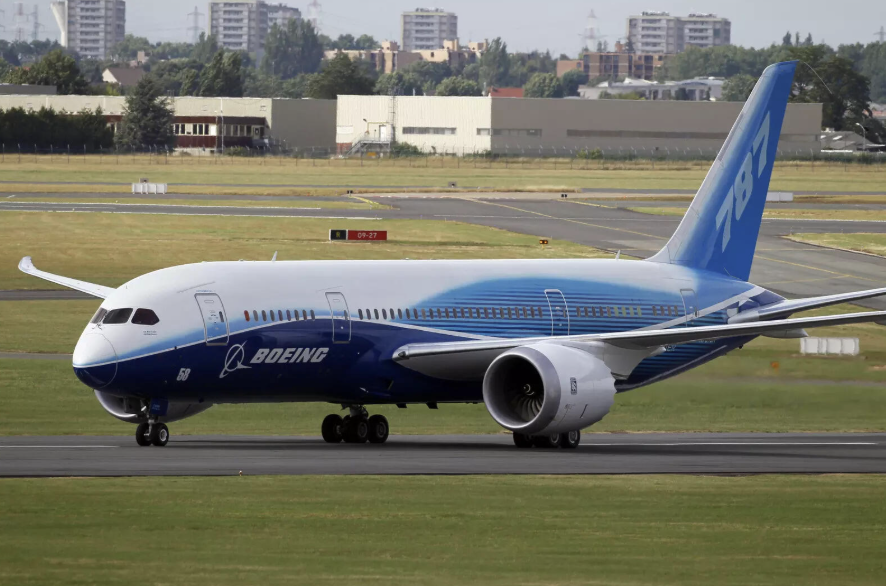
If you have ever flown commercially, chances are you have flown on a Boeing at least a couple of times.
Founded in 1916 in Seattle, WA, the aircraft manufacturer first built its reputation within the domestic industry. Over time, Boeing grew rapidly, becoming one of the two main producers of large passenger planes worldwide—competing with Airbus in a so-called duopoly. This unique scenario of having only one major rival meant less competition, but it also made every new plane a huge bet for the company. That is where the Boeing 787 comes in.
As one of the newer models, the aircraft is capable of flying over 14.000 km at a maximum speed of Mach 0.9, all while burning around 20% less fuel than older planes—making it one of the most efficient models on the market. What is more important for passengers is that the 787 made it possible to connect mid-sized cities directly, rather than making us spend endless hours in connecting hubs. Overall, the plane, which is currently used by around 90 airlines worldwide, was built to be more efficient and more adaptive to the objective put in front of it. However, what now looks like a major success for Boeing could never become a reality, all because of one mistake that was, in theory, simple, yet, in reality, very difficult to see.
In 2004, Boeing came up with a new strategy that was supposed to save billions in constructing the new aircraft. Instead of building the plane itself, the manufacturer decided to offshore about two-thirds of it to other companies. In simple terms, offshoring means paying another company to do work you would normally do yourself, such as paying Japan’s Mitsubishi to produce the wings or Italy’s Alenia to make stabilizers, without which taking-off would become impossible. The idea was to let every company focus on a specific part, which would later be flown to the main assembly factory near Seattle where, just like Lego, the parts would be put together.
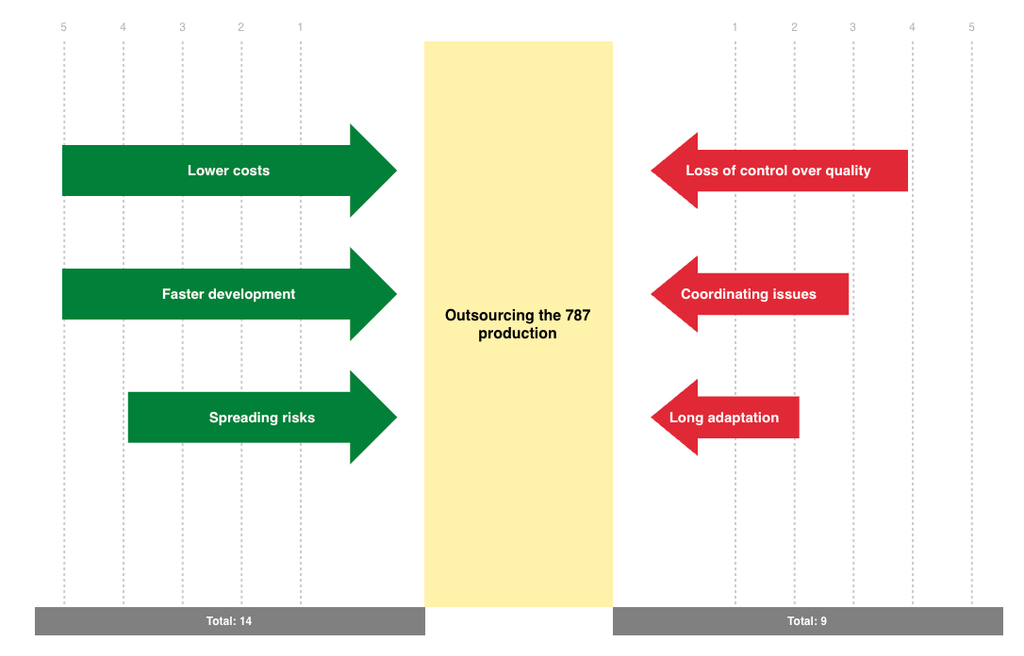
Figure 1: Force Field Analysis of Boeing’s offshoring strategy
Needless to say, that was a bold decision, but a very thoughtful one. Force Field Analysis helps illustrate that decision from the managerial point of view. By focusing on one particular part, each partner was expected to work with the highest efficiency and at a lower cost, rather than trying to chase everything and ending up losing it all. More importantly, these decisions implied economies of scale: a situation in which the average cost of each unit decreases as a company produces more of it. The restraining forces that could arise, like a loss of control or a lengthy adaptation period, were real and were definitely considered by the company; yet, back then, they were not assumed to be significant enough to give up on the strategy. Weighing the estimated advantages and disadvantages of this decision, the possible gains significantly outweighed the losses (14 to 9), which made it look like a low-risk, high-reward situation.
However, the very issues that seemed unimportant turned out to be the ones that mattered the most. In July 2007, a crowd cheered the first public appearance of the 787. Little did they know that right after the event, the aircraft went straight back into the hangar to be torn apart, as it was put together using cheap aluminum and did not have anything inside. Boeing was not only late—it was failing to produce the key parts of the airplane. Suppliers that had never made such details before ended up shipping them incomplete, which meant that Boeing had to make unexpected additions itself. On top of that, coordination issues became evident, as the manufacturer faced a significant shortage of bolts. Something as basic as this held up the entire program, just because Boeing could no longer see its own supply chain.
| Year | 2007 | 2008 | 2009 | 2010 |
| Operating income | $3.584 B | $1.186 B | -$583 M | $3.006 B |
| Revenue | $33.386 B | $28.263 B | $34.051 B | $31.834 B |
| Operating profit margin | 10.7% | 4.2% | -1.7% | 9.4% |
Figure 2: Operating profit margins for Boeing Co., 2007-2010
We can observe the scale at which the strategic failure affected Boeing’s financial results by referring to operating profit margins. They illustrate how much of operating income a company generates for every dollar of revenue earned before accounting for taxes and interest rates, allowing to directly trace the change and its outcomes. Operating profit margins are given by the following formula: (Operating income Revenue)x100. In 2007—the year the 787 was presented—Boeing’s commercial business was strong, with an operating profit margin of 10.7%. However, as time passed and the delays became more and more evident, the margin fell significantly, dropping to -1.7% in 2009. The margin only recovered in 2010 once those issues were behind. Although many other factors could have affected these margins, such as the worker strikes, the 787 was Boeing’s largest project at the time, and its delays line up with the company’s worst years, which makes this connection strong.
Interestingly, the problem Boeing stumbled upon is explained by economic theory. In particular, transaction cost economics implies that buying from another company has costs beyond the price, especially when it comes to maintaining quality and timely delivery, something Boeing struggled with. The estimated restraining forces turned out to be far more significant in reality, which made the hidden costs swallow the planned savings and much more. Transaction cost economics also states that when the external suppliers end up costing too much, firms end up bringing the production back in-house. And that is exactly what happened: in 2009, Boeing bought out the producers of the rear and middle fuselage sections, the ones where the delays were most significant. Once the manufacturer regained control and the supply chain finally settled, the scale benefits slowly started to appear.
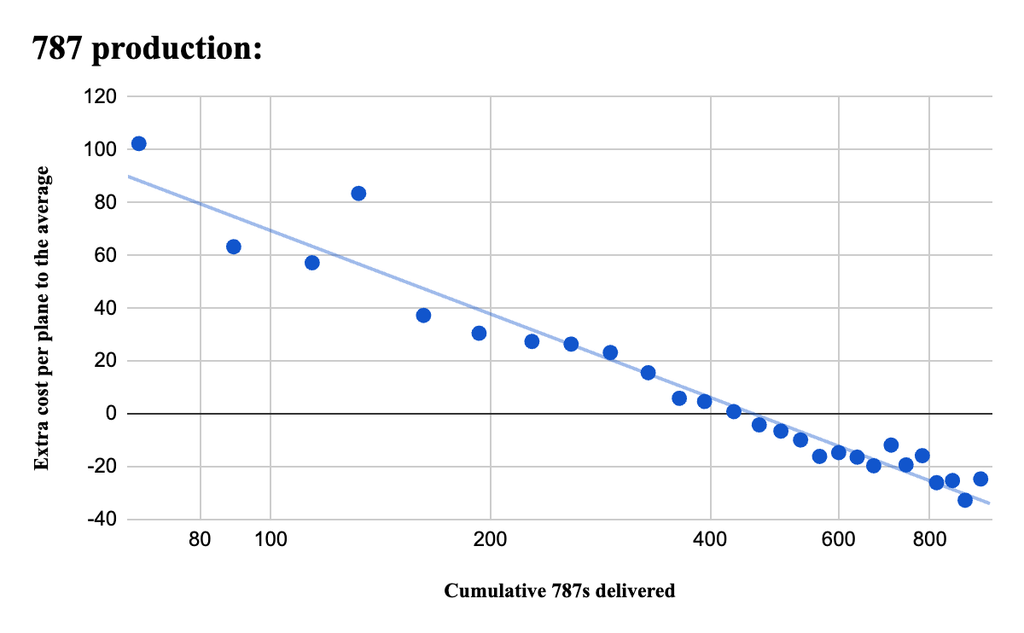
Figure 3: Extra cost per Boeing 787 relative to the average, Q2 2013 – Q4 2019
By applying multiple linear regression analysis to Boeing, we can see how in the long run, the offshoring strategy did what it was intended to do—lower the extra cost of producing the airplane. To find this, the gained experience and the production rate were taken as a variable, as both help estimate the final production cost from 2013 to 2019, the period of steady 787 deliveries. The most interesting finding was that the main driver was experience itself. On average, every plane cut about $0.12 million off the extra cost of the next one, with early planes cutting even more than later ones, showing how growing knowledge of producing a completely new aircraft made it possible to lower the hidden costs described in the transaction cost economics theory. Overall, each 787 only stopped adding to the losses after about 450 planes were built, almost five years after the first delivery. Economies of scale did arrive, but much later than planned.
In conclusion, Boeing’s offshoring strategy stands as an example of a strategy that looked brilliant on paper, but, in practice, cost billions rather than saving them. The manufacturer hoped to become faster and more efficient, yet the hidden costs of coordinating suppliers and fixing the small problems that arose delayed the 787 by years before its first take-off. This experience highlights that any strategy, even if it looks amazing, should be analyzed carefully and from multiple perspectives before making a decision. But on a final note, it is important to say that today, the 787 is a huge success, showing that the idea itself was not wrong: it all came down to how it was implemented.
Bibliography:
News, NBC. ‘A Wing and a Prayer: Outsourcing at Boeing’. NBC News, NBC News, 20 Jan. 2011, www.nbcnews.com/id/wbna41175764.
Agronsky, Victoria. ‘The Problem Boeing Ran Into After Outsourcing 787 Production’. Simple Flying, 29 Jan. 2026, simpleflying.com/boeing-problem-after-outsourcing-787/.
Hayes, Adam. ‘Multiple Linear Regression (MLR) Definition, Formula, and Example’. Investopedia, 14 Apr. 2025, www.investopedia.com/terms/m/mlr.asp
The Boeing Company. Annual Reports (Form 10-K), Fiscal Years 2007–2019. EDGAR, U.S. Securities and Exchange Commission, 2008–2020, www.sec.gov/edgar/browse/?CIK=12927.
The Boeing Company. Quarterly Reports (Form 10-Q), 2011–2019. EDGAR, U.S. Securities and Exchange Commission, 2011–2019, www.sec.gov/edgar/browse/?CIK=12927.
Wikipedia Contributors. ‘Transaction Cost’. Wikipedia, Wikimedia Foundation, 18 Feb. 2019, en.wikipedia.org/wiki/Transaction_cost.
Hayes, Adam. ‘Multiple Linear Regression (MLR) Definition, Formula, and Example’. Investopedia, 14 Apr. 2025, www.investopedia.com/terms/m/mlr.asp
“Boeing Reports Quarterly Deliveries.” Boeing MediaRoom, The Boeing Company, 2012–2019, boeing.mediaroom.com/news-releases-statements.