
Elizabeth Holmes was declared the world’s youngest self-made female billionaire at age 30, in 2014. She was the founder and CEO of Theranos, a blood-testing company developing fast, cheap, and less invasive diagnostic screenings using blood obtained from a simple finger prick. However, her promising career soon crumbled, tragically, into countless lawsuits and the collapse of her business.
Building Theranos
In 2002, Holmes enrolled at Stanford to pursue a degree in electrical and chemical engineering. However, during her sophomore year, she dropped out. She reported being sexually assaulted during her time at university, and said that contributed to her decision to dedicate herself to entrepreneurship. Between 2003 and 2014, Holmes began to build both Theranos and her public image. In meetings, she lowered the pitch of her voice and wore shoulder pads to come across as more authoritative. In photographs, she wore black turtlenecks. Her carefully constructed persona reinforced her as an ambitious and confident college-dropout entrepreneur.
As Theranos grew, Holmes instituted intensive measures of secrecy and security regarding most aspects of production. Nevertheless, its promises attracted substantial investment and interest from the medical world. In 2013, Walgreens announced a partnership with Theranos to establish wellness centers inside its pharmacies, making the company’s blood tests more accessible to the public. A year later, Theranos claimed to offer diagnostic testing for more than 200 medical conditions. It was licensed to operate in almost all U.S. states, and held certification from the Centers for Medicare & Medicaid Services (CMS)—the federal agency that oversees medical laboratories. Forbes magazine named Holmes as one of the richest women in America, valuing her personal wealth at approximately 4.5 billion and her company at 9 billion. With her youthful ingenuity and domineering leadership style, she became Silicon Valley’s celebrated “it girl”.
The Troubles Begin
The company’s problems began in 2015, when employees raised concerns about how other employees were tampering with statistical data and test results from Theranos’s main proprietary technology, the allegedly revolutionary Edison machine. These whistleblowers shared this information with The Wall Street Journal, and shortly after, one of its reporters revealed in an article that the Edison was being used only for a fraction of the company’s tests and produced unreliable results, despite Holmes’s repeated claims to the contrary. He also reported that Theranos scientist Ian Gibbons had died by suicide in 2013 after struggling with the pressures of working for Holmes.
Further questions concerning the company’s secretive processes soon surfaced. The U.S. Food and Drug Administration criticized Theranos for failing to subject its technologies to scientific peer review. In 2016, CMS blocked Theranos from receiving reimbursements from Medicare and Medicaid and forbade Holmes from possessing or operating a medical laboratory for two years.
Criminal Charges
In March 2018, the U.S. Securities and Exchange Commission charged Holmes and her business partner Ramesh “Sunny” Balwani with fraud, for allegedly taking more than 700 million from investors while advertising a false product. Holmes settled the SEC’s charges by paying a $500,000 penalty, surrendering nearly 19 million shares, relinquishing her voting control of the company, and accepting restrictions on her ability to serve as an officer or director of a public company. That settlement was separate from the criminal proceedings that followed.
Later in 2018, after a federal grand jury returned an indictment in June—charging Elizabeth Holmes with crimes in connection with schemes to defraud investors, doctors, and patients—she was forced to relinquish control of Theranos. Later that year, Theranos ceased operations. Its collapse resulted in losses for private investors and medical harm to patients who relied on its inaccurate blood tests.
The original indictment was subsequently superseded in July 2020. The indictment alleges that
Holmes defrauded doctors and patients by firstly, making false claims concerning Theranos’s ability to provide accurate, fast, reliable, and cheap blood tests and test results, and secondly, by omitting information concerning the limits of and problems with Theranos’s technologies.
It also reveals that Holmes made numerous misrepresentations to potential investors about Theranos’s financial condition and its future prospects. She claimed Theranos would generate over 100 million in revenues and break even in 2014, and that Theranos expected to generate approximately 1 billion in revenue in 2015, when in reality, she knew Theranos would generate only negligible or modest revenues in 2014 and 2015.
The indictment charged Holmes with two counts of conspiracy to commit wire fraud, and nine counts of wire fraud. In January 2022, a jury found her guilty on four counts relating to defrauding investors, and was acquitted on some other counts. In November 2022, Holmes was sentenced to 135 months in federal prison for defrauding investors. She was also ordered to serve three years of supervision following release from prison. On April 27, 2023, she surrendered to begin her sentence at the Federal Prison Camp Bryan in Bryan, Texas.
New Developments
Despite the legal proceedings, Holmes’s story continues to evolve. While facing criminal changes, she fell in love and married Billy Evans. She became a mother of two children. She goes by Liz now, and speaks in her natural voice. She also volunteered for a rape crisis hotline before beginning her sentence.
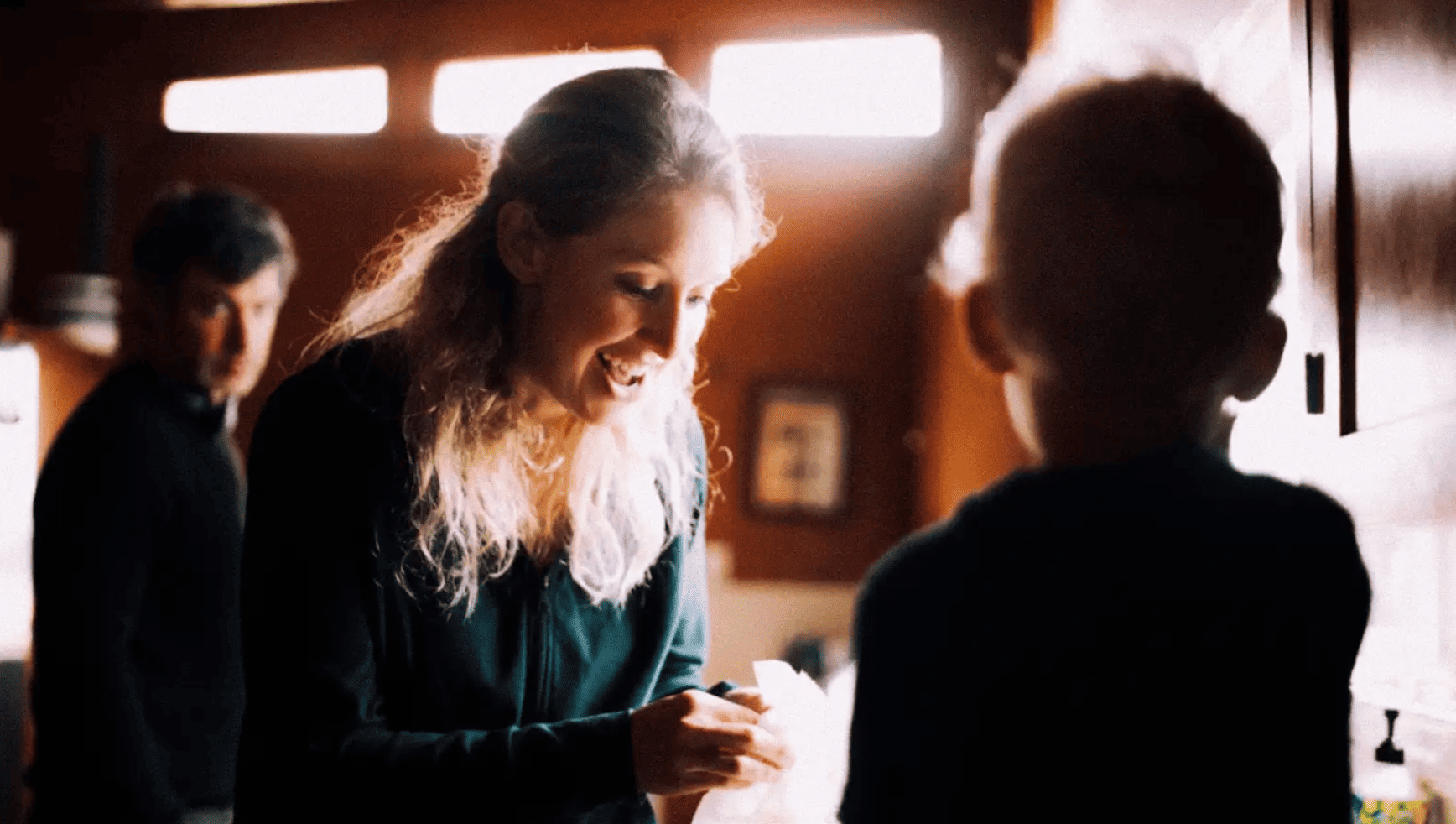
Her participation in Nathan Fielder’s documentary You Can See Everything has triggered a controversy about how her story should be understood, and debate about broader themes of manipulation, ethics, and truth. The film follows Holmes in the weeks before she entered prison and two years into her sentence. It attracted widespread attention, because it combines real-life reporting and psychological theater. The New Yorker describes it as a movie of “dazzling conundrums and vertiginous paradoxes.” In the documentary, Holmes maintains that she is innocent. When Fielder asks whether she genuinely believes she didn’t commit a crime, she responds, “I know I didn’t commit any crime,” according to The New Yorker. She claims that she wanted it to correct the public narrative, and to present her story as a “human story.”
Throughout the documentary, Fielder frequently appears on screen, questioning Holmes’s statements, following up on the disconnect between her account and the established record. Holmes repeatedly assures Fielder she has nothing to hide, yet over and over again, his probing questions catch her in slippery half-turths. She is remarkably insistent on her inability to lie, or even inadvertently deceive, which raises the troubling possibility of a person, consciously or not, constructing their own version of honesty which contradicts all the evidence against them. Her manner of speaking is equally confusing; she often smiles while talking and maintains intense eye contact, creating an impression of confidence and composure. The glassy, translucent blue quality of her eyes is also slightly unnerving.
Ultimately, You Can See Everything highlights the importance of the relationship between a filmmaker and his subject. By allowing Holmes to participate in the reconstruction of her public narrative, Fielder creates a work that invites audiences to question whether she has deceived herself. Her story reminds us how quickly things can go downhill. Holmes began as an inspiration for young women hoping to become entrepreneurs, until she ended up in prison. Her downfall warns us of the dangers of reckless ambition and corporate deception. Now, this new documentary has given us the opportunity to reconsider how we want to remember her. Is she an impressive businesswoman, a manipulative liar, or an innocent mother who was wrongly accused? It has also given her the chance to tell her side of the story—and possibly to create a new one, if we want to give her the chance.
Bibliography:
“Elizabeth Holmes.” Encyclopaedia Britannica, https://www.britannica.com/money/Elizabeth-Holmes. Accessed 2 Nov. 2026.
“Elizabeth Holmes Is Not the Problem With ‘You Can See Everything.’” TIME, 15 Oct. 2026, https://time.com/article/2026/10/15/you-can-see-everything-movie-review/.
Brody, Richard. “The Vertiginous Revelations of ‘You Can See Everything.’” The New Yorker, 9 Oct. 2026, https://www.newyorker.com/magazine/2026/10/19/you-can-see-everything-movie-review.
“U.S. v. Elizabeth Holmes, et al.” U.S. Attorney’s Office, Northern District of California, U.S. Department of Justice, https://www.justice.gov/usao-ndca/us-v-elizabeth-holmes-et-al. Accessed 2 Nov. 2026.