
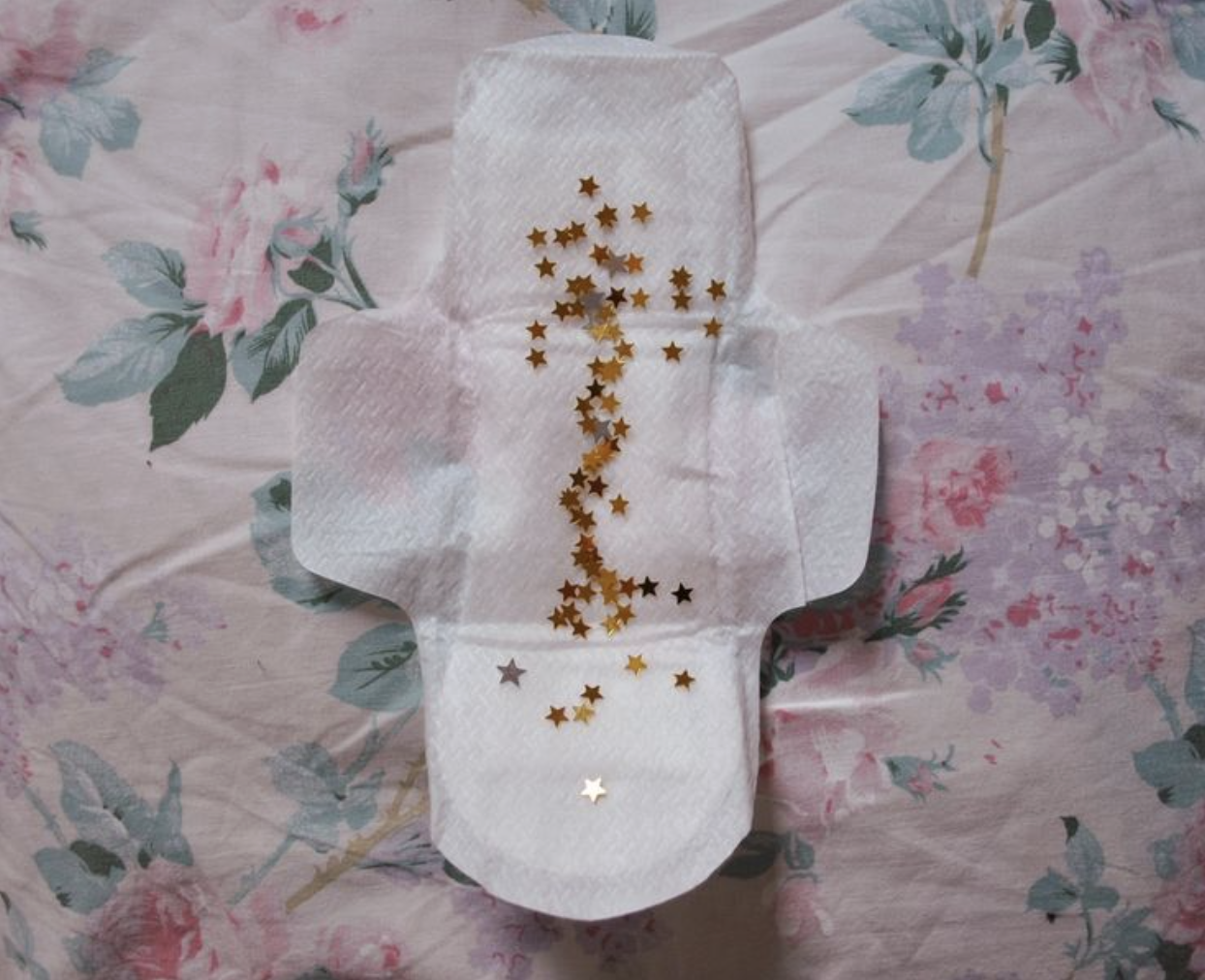
Picture this: you’re in one of the stalls of the girls’ restroom. You’ve finished using the toilet, but just as you’re about to stand up, you realize that your period has started. You panic for a moment, not fully knowing what to do, but eventually muster up the courage to ask the notoriously scandalous question into the abyss of the girls’ room. You ask, “Does anyone have a pad?” and out of that abyss responds a myriad of answers. Probably over half of the women in that restroom respond to your question, and currently, you’re not worried about not having a sanitary pad to use—you’re overwhelmed with how many choices you now have. In many societies, having your period is portrayed as shameful and almost secretive, as though it were something that men should be shielded from and ought to only be shared among women. But why is this the case?
I think that for most of us women, this scenario likely sounds quite familiar—I mean, let’s be real, we’ve all been there. But despite it being familiar, I’m sure that while reading this you felt a bit uncomfortable in some way or another. Maybe it’s because you imagined yourself in that unnerving scenario, or perhaps because you are wondering why this random girl is talking to you about periods in the school newspaper. Society has conditioned us to feel our stomachs churn just reading that intro—but why? Why are we so embarrassed about a process that is biological, normal, and even essential for creating life?
Why are periods so shameful and where do we see this stigmatization in real life?
A large part of the reason why menstruation is viewed as something gross or embarrassing comes from the way in which we first learn about periods. In fifth grade, the counselors came to our classrooms and split the class in half; the girls stayed in one room and the boys went across the hall to another. I haven’t the slightest idea what the boys were told in their room, but in the girl’s room, we were given a whole run-through of the next thirty years of our lives. We’ll reach puberty and the lining of our uteruses will shed and bleed every month for the next few decades until we eventually reach menopause. Period, the end. Except that this run-through is not where the story ends—it’s only the beginning. They taught us how our bodies would change, but not how society would treat us because of it.
The fact that the boys and girls were separated in the first place creates so much space for stigmas to arise and for childish concepts such as “cooties” to form. Again, I don’t know what was taught in the boys’ room, but I doubt that they were told anything remotely close to the female menstrual cycle. Since boys only learn about periods during high school or even later in life—depending on the education system—they aren’t able to construct a full understanding of what menstruation truly is. This can therefore lead them to think of periods as something disgusting or believe that the pain women experience during menstruation is exaggerated.
In general, I have noticed that a large portion of the shame that has been created around periods originates from these prejudices which come from a lack of information about the female cycle. Some common remarks that reinforce this stigma include: “she’s emotional so she must be on her period,” “period blood is dirty,” and the classic “period cramps don’t hurt as bad as being kicked in the balls.” While some of these misconceptions may have a bit of truth in them—such as periods sometimes making women more emotional because of the hormone fluctuations—as a whole, these comments are demeaning and simply paint periods as something unhygienic.
I cannot begin to tell you the amount of times that a girl has whispered to ask me if I had a period product and then hid it in her pocket sleeve once I gave her one. We don’t hide bandaids when we get a bloody knee, so why are women expected to hide period pads or tampons when we get our periods? Women should not have to feel this way, especially about a biological process that we can not even control. Periods must be de-stigmatized—and that starts by teaching it correctly in the classroom.
Why periods should be de-stigmatized
The fact of the matter is that de-stigmatizing menstruation is about much more than just avoiding embarrassment. This process of normalizing periods is about breaking this silence out of medical urgency and basic human rights.
Women have been excluded from scientific research for centuries. In fact, the airbag safety measures on cars were originally designed for men and tested by male dummies. This means that when women get into frontal car crashes, they face an estimated 47% higher risk of serious injury compared to men, which is largely because the safety features in cars have historically been calibrated around the average male body. So if society hasn’t been able to include women in basic safety testing for vehicles, what incentive would they have to actually study the issues that impact women specifically? And that’s the issue—there is no incentive.
This means that several chronic medical conditions that solely impact women have been greatly overlooked and under-studied. Some of the more acknowledged conditions include endometriosis and Polycystic Ovary Syndrome—both of which are conditions that cause extremely painful cramps in the lower abdomen due to hormonal imbalances (PCOS) and the growth of uterine tissue lining in abnormal places (endometriosis). And although there has been a recent surge of research surrounding these conditions, there is still no cure since medical advancements related to the menstrual cycle are progressing slowly.
Moreover, in many regions around the world, period products are inaccessible to a large number of women. For instance, in Kenya, 65% of women cannot afford period products, and many girls are forced into sexual exploitation in exchange for menstrual products because these necessity goods are priced like luxury items.
Nevertheless, this situation is not entirely grim. In 2020, Scotland became the first country to provide free sanitary products to women who needed them. These products can be accessed in community centers, youth organizations, and in pharmacies. Since then, other countries have been incentivized to make menstrual products more accessible, specifically by making them free in school environments. However, free period products alone will not eradicate menstrual inequality and period poverty. Leah Rodriguez in a Global Citizen article about period poverty highlighted that other measures like proper education, access to water and sanitation, and addressing harmful gender stereotypes are necessary actions too.
What can we do?
It’s unreasonable for me to ask you to do something extreme like find a cure to endometriosis or fly to Kenya to provide period products for impoverished women, but I don’t think that basic activism is too much to ask. Every change begins with speaking up about the injustice and bringing awareness to the issue. Us women can help by voicing our needs and being louder about period equality. And don’t get me wrong, women aren’t the only ones who can help alleviate the stigma around periods—men can, and should, fight for gender equality as well. In the end, gender equality is just one piece of the broader human rights issues that persist today. If we work as a collective society to speak up about this issue, we can make a large difference to the overarching equality of this world.
Bibliography:
Cleveland Clinic“Endometriosis: Causes, Symptoms, Diagnosis & Treatment.” Cleveland Clinic, 16 Sept. 2024, my.clevelandclinic.org/health/diseases/10857-endometriosis. Accessed 10 Sep. 2026.
Intimina Blog“Period Poverty Around the World.” Intimina Blog, www.intimina.com/blog/period-poverty-around-the-world/. Accessed 23 Sep. 2026.
Mayo Clinic“Polycystic Ovary Syndrome (PCOS).” Mayo Clinic, www.mayoclinic.org/diseases-conditions/pcos/symptoms-causes/syc-20353439. Accessed 9 Oct. 2026.
PMC / National Institutes of Health“PMC3222446.” PubMed Central (PMC), National Center for Biotechnology Information, pmc.ncbi.nlm.nih.gov/articles/PMC3222446/. Accessed 23 Sep. 2026.