
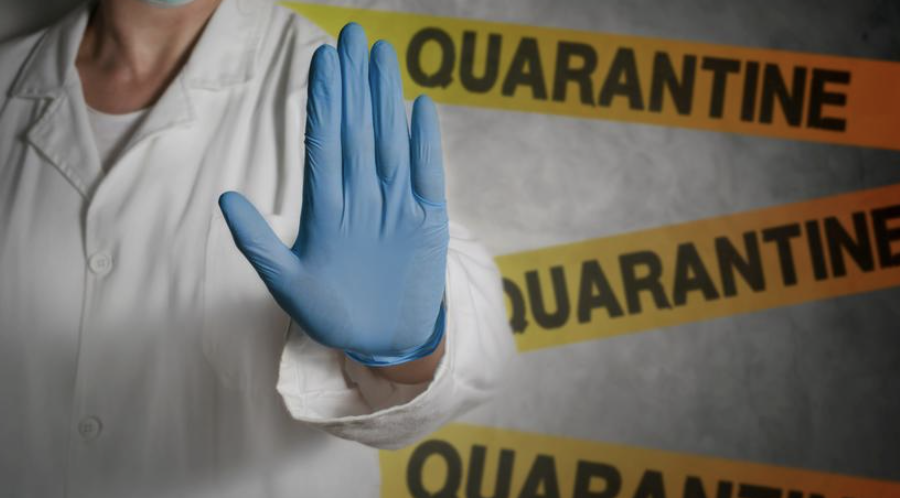
Six years ago, in 2020, COVID-19 was officially declared a global pandemic. Society went into a panic, and, in an attempt to better control the disease, shut everything down. The world was on lockdown. People were forced to stay inside—working and entertaining themselves from the safety of their homes. All public areas were closed, including schools, workplaces, grocery stores, and gyms.
Quarantining is seen as a mandatory step to preventing the spread of disease. It is considered to be an important and effective method that allows society to remain safe and control the outbreak of a disease quicker and more efficiently. Despite the supposed effectiveness of this precaution, many flaws are also present, which in some cases override the benefits of it. Society being forced to stay inside and away from other individuals led to immense struggles regarding mental health, the economy, and education. Quarantining did not have the positive effect the world anticipated, and some formerly apparent problems have persisted, remaining evident today.
Due to new diseases becoming more of an issue today, officials worry that a pandemic may strike once again, with lockdowns needing to be enforced for a second time. Diseases such as COVID-19 variations and the anxiety-inducing Hantavirus have led people to believe that the COVID pandemic may not be the only one generations who experienced it will live through.
That being said, what would happen if society were faced with a similar situation and forced into another lockdown? Considering the negative effects of the previous COVID quarantines, what would be the impacts of another pandemic?
Unfortunately, due to the nature of this particular precaution, many of the negative effects that came with quarantining would likely still be present in another lockdown. In fact, there is a high probability that some of these effects would come back stronger the second time around and would impact society worse. This is especially true for young people’s mental health, since many adolescents are still recovering from the last lockdown.
During the COVID-19 lockdown, the mental health of society, specifically adolescents, experienced a great depletion. In fact, 17.6 % of students were said to have experienced psychological or behavioural issues during online schooling in the lockdown period. This would very likely return during another quarantine, as the effects of the lockdown would remain effective on adolescents and society in general. Increased screen time, as well as social isolation and financial stress, has created a far greater psychological stress as a whole as well.
In addition to this, the overuse of technology during the lockdown led to a 1.4–3% increase in myopia cases in children. If another quarantine were implemented across society, this percentage could increase even more than it did during the COVID quarantine, especially given the constant rise in technology use among teenagers and children.
Moreover, Japan recorded a 49% increase in suicidal rates among kids and adolescents during the second COVID-19 lockdown. Given that this increase occurred during the second quarantine instead of the first, an additional lockdown being forced upon society would likely lead to a drastic spike in these rates.
While quarantines may be deemed necessary to slow the spread of disease and control society when a pandemic is in place, there are also many consequences of forcing society into isolation. Not only are the detriments of quarantines possible reasons for potential future lockdowns to appear less reasonable, but studies have shown that quarantines may not even have the full effect of controlling the spread of disease.
A former study compared four Scandinavian countries who had different lockdown severities. While countries such as Finland, Denmark, and Norway imposed strict lockdowns on society, others, like Sweden, did not find this necessary. The excess deaths of each of the countries were measured and compared over time, and while non-quarantined countries’ excess deaths spiked during the beginning of the pandemic, by the end of it, numbers for all four countries had averaged out and became relatively the same. This goes to show that while quarantines definitely do help maintain some control in the spread of disease during a global pandemic, they aren’t completely positive, and it is essential for society to be aware of the effects that may come from imposing a lockdown on the world.
Ultimately, if a second lockdown were to be set in place, immense impacts would be found. Mental health would deplete greatly, in addition to there becoming drastic economic failure and financial struggles to become much more apparent. Though lockdowns may seem necessary to stop the spread of a disease, is it really worth it when we consider the side effects?
Works Cited
Baranuik, Chris. “Five years on: The countries that never locked down for Covid-19.” BBC, 5 March 2025, https://www.bbc.com/future/article/20250304-the-countries-that-never-locked-down-for-covid-19. Accessed 27 May 2026.
Geddes, Linda. “Six major health threats that could shape 2026: here’s what experts are watching.” Gavi, the Vaccine Alliance, 19 February 2026, https://www.gavi.org/vaccineswork/six-major-health-threats-could-shape-2026-heres-what-experts-are-watching. Accessed 27 May 2026.
Meo, S.A., Abukhalaf, A.A., Alomar, A.A. et al. Impact of lockdown on COVID-19
prevalence and mortality during 2020 pandemic: observational analysis of 27 countries. Eur J Med Res 25, 56 (2020). https://doi.org/10.1186/s40001-020-00456-9
Kumar N, Ramphul K, Mejias SG, Lohana P, Verma R, Ramphul Y, Sonaye R. The impact of COVID-19 lockdown on children and adolescents and possible solutions: a perspective. Arch Med Sci Atheroscler Dis. 2021 Jun 30;6:e115-e119. doi: 10.5114/amsad.2021.107811. PMID: 34381911; PMCID: PMC8336433.
“WDR 2022 Chapter 1. Introduction.” World Bank, https://www.worldbank.org/en/publication/wdr2022/brief/chapter-1-introduction-the-economic-impacts-of-the-covid-19-crisis. Accessed 27 May 2026.