
The blue whale—the largest creature to ever exist—plays a monumental role in the ocean’s health, not just during its life but for decades after its death. While these 100-foot behemoths seem invincible, they face unique threats from both nature and humanity before eventually transforming into colossal islands of nutrients on the deep seafloor.
Life cycle of a whale
Different species of whales live for different amounts of time. That being said, all whales go through four key stages of their life.
First is birth and calfhood—which is the equivalent of childhood for humans. Mostly born in shallow and warmer waters, whales grow rapidly, consuming hundreds of liters of high-fat milk daily, and learn to socialize and breathe immediately.
Next is adolescence—which is the same term used to describe the stage that humans also experience. As they leave their mothers, adolescent whales travel in pairs or small groups. During this stage, they master filter-feeding (for baleen whales) or hunting (for toothed whales) and complete their first independent migrations.
The most important and longest stage of the whale’s journey is adulthood. Whales become sexually mature between six and ten years of age. Adults, such as humpbacks, typically return to warm, tropical waters to mate and give birth every two to three years.
Finally, they die and go through whale fall, which is the last contribution they bring to the ecosystem.
The lifespan of a whale varies depending on the species, with humpbacks living roughly 45–50 years, blue whales living 70–90 years, and bowhead whales being capable of living over 200 years.
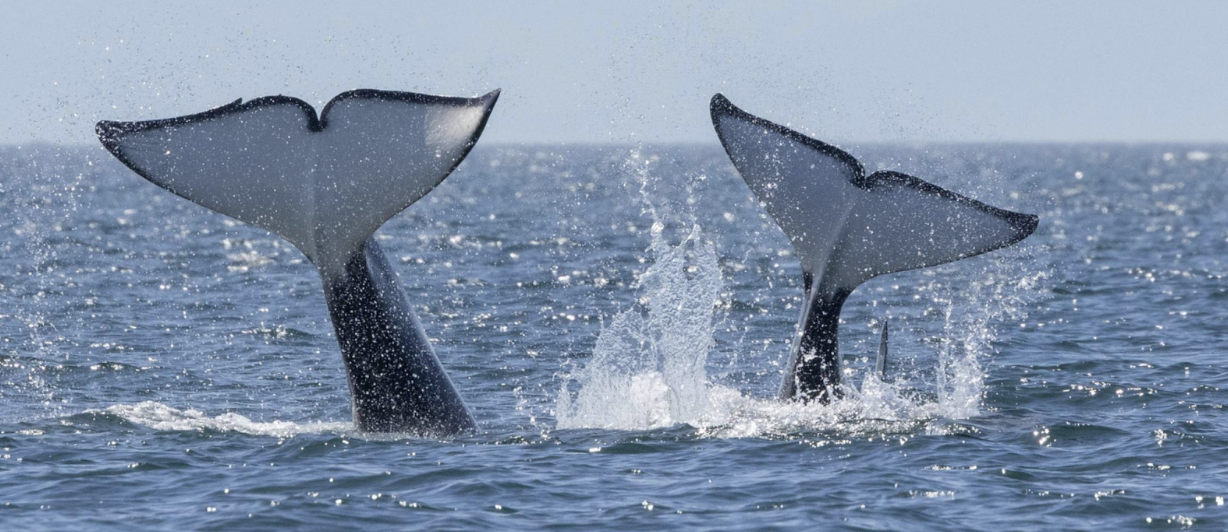
The only natural predators capable of challenging a blue whale are the killer whales (orca). Known as the “wolf packs of the ocean,” orcas are highly intelligent hunters that primarily target juvenile whales and calves. In fact, there are few reported cases of orcas harassing adult whales, since orcas generally prefer smaller prey such as the smaller pygmy blue whale subspecies.
However, the greatest threat to blue whales is humanity. Before international bans were enacted in the 1960s, industrial whaling decimated populations, killing approximately 99% of all blue whales within a few decades. Today, while intentional hunting has ceased, humans still kill an estimated 1,500 whales annually, largely through boating accidents and ship strikes.
The deep-sea banquet: Whale falls
When a whale dies far out at sea, its body eventually loses buoyancy and sinks through the darkness of the ocean into the abyss. This event, known as a “whale fall,” provides the largest single input of organic matter to reach the deep-sea floor at any one time. A single carcass can provide nutrients equivalent to thousands of years of “marine snows” (tiny ocean particles), sustaining a complex ecosystem for up to 50 years. The decomposition happens in three fascinating stages:
- Mobile Scavenger Phase: Big animals like hagfish, sleeper sharks, and rattail fish arrive to strip the flesh and blubber. Hagfish are particularly specialized, diving into the carcass to eat it from the inside out.
- Enrichment-Opportunist Phase: Once the bones are exposed, they are colonized by thousands of smaller organisms, including the “bone-eating snot-flower” (Osedax). These worms use acid to tunnel into the skeleton and absorb nutrients directly.
- Sulphophilic Phase: In the final stage, bacteria break down the remaining fats in the bones, releasing the hydrogen sulfide. This supports “chemosynthetic” life forms that create energy from chemicals rather than sunlight.
Whale falls are more than just a food source—they are critical for biodiversity. They act as stepping stones, allowing specialized deep-sea creatures to survive and disperse across the otherwise barren ocean floor. In death, the whale provides its final gift to the Earth: a thriving, unique ecosystem that continues to surprise scientists with its complexity.
Bibliography:
Desk, TOI Lifestyle. “The Strange Deep-Sea Creatures That Eat Whales and How They Turn Death into Life.” The Times of India, The Times Of India, 18 Mar. 2026, timesofindia.indiatimes.com/etimes/animals/the-strange-deep-sea-creatures-that-eat-whales-and-how-they-turn-death-into-life/articleshow/129655559.cms. Accessed 19 Mar. 2026.
Latham, Katherine. ““We’re Constantly Surprised”: The Strange Deep-Sea Creatures That Eat Whales.” Bbc.com, BBC, 14 Mar. 2026, www.bbc.com/future/article/20260311-the-strange-deep-sea-creatures-that-eat-whales.Maxwell, Colby. “Blue Whale Predators: What Eats a Blue Whale?” AZ Animals, 26 May 2022, a-z-animals.com/blog/blue-whale-predators-what-eats-a-blue-whale/.