
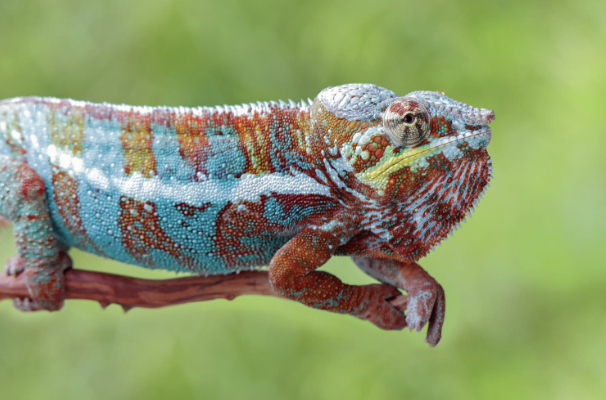
Chameleons are fascinating creatures. Most people know them for their weird monocular vision and their quick, sticky tongues. However, not many people understand how their color shifting ability actually works. In reality, their famous color shifts are more than just a striking feature. Instead, they come from a complex biological system inside their skin.
Many animals change color using pigments, but others, like cephalopods, chameleons, and some fish, rely on both pigments and nanostructures in their skin.
To understand how these animals change their color, it is essential to define what scientists call a nanostructure. According to ScienceDirect, a nanostructure is “a small object of intermediate size between molecular and microscopic (micrometer-sized) structures.”
This concept is a crucial one for nanotechnology. Scientists study these biological systems to develop synthetic, color-changing nanomaterials based on their nanostructures. Today, nanotechnology can be found in all kinds of everyday objects. From stain-repellent clothing, sunscreens with transparent nanoparticles, self-cleaning paint, lightweight sports equipment, and even targeted cancer drug delivery systems, it’s mind-boggling to think that these revolutionary innovations only exist because scientists study organisms that use nanoscale engineering.
The chameleon is one of the most intriguing examples. These creatures rely on two key types of nanostructures built into their skin: iridophores, which contain nanocrystals that reflect iridescent blue light in their resting state, and chromatophores, pigment-containing cells that allow for rapid change in coloration.
The combination of these nanostructures allows chameleons to manipulate light through structural coloration. When a chameleon becomes excited or relaxed, the animal physically stretches its skin. The spacing shifts between the nanocrystals in the iridophores, causing a change in structure and allowing them to reflect and absorb different wavelengths of light. When the crystals are closer together, they reflect shorter wavelengths, such as blue. However, when the skin stretches and the crystals move further apart, they reflect longer wavelengths, like yellow, orange, or red.
At first glance, it appears as though this skill is only used for camouflage. In reality, it serves many other purposes. Chameleons use bright or contrasting colors to communicate dominance, submission, or readiness to mate. They also change their color to regulate their body temperature: darker tones absorb more heat, while lighter tones reflect it. Additionally, structural coloration mechanism allows them to conserve energy because they can produce vivid colors without needing to constantly generate pigments.
This nanoscale adaptation isn’t limited to reptiles. As a matter of fact, evolution has allowed for similar modifications in marine species, despite their dramatic difference in environment.
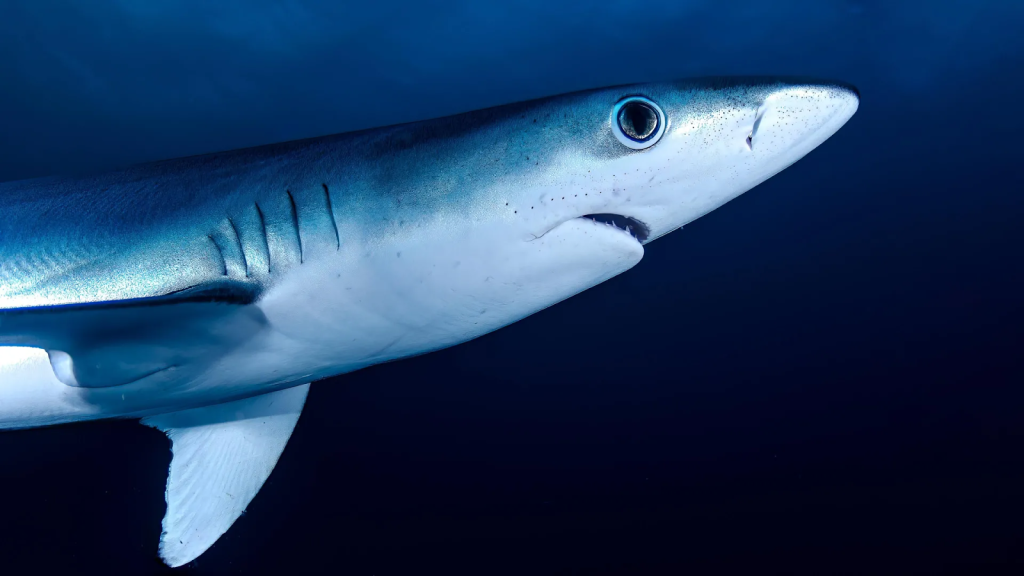
Image of Prionace glauca from ScienceDaily
A 2025 study from the City University of Hong Kong reveals that a blue shark species Prionace glauca uses nanostructures inside pulp cavities of their dermal denticles—the tiny, tooth-like scales that cover its skin. These denticles contain guanine crystals that act like mirrors, reflecting blue light and giving the shark its vibrant blue color. The cavities also have melanin-filled vesicles called melanosomes, which absorb other wavelengths. Because water pressure changes with depth, small vertical movement in the water can slightly change the spacing of their nanostructures. This shifts the wavelengths they reflect and allows them to rapidly change their color. Their structural coloration enhances their ability to camouflage in the open sea by letting them blend with the surrounding water and avoid becoming detected by both predators and prey.
These tiny structures end up giving animals like chameleons and sharks a wide range of powerful advantages—from camouflage and communication to energy efficiency and thermal regulation—allowing them to quickly adapt to their surroundings and improve their chances of survival.
So while nanostructures increase animals’ chance of survival, they also influence human innovation. By studying creatures like chameleons and blue sharks, scientists have developed new materials for medicine, electronics, energy, and environmental sustainability. Isn’t it incredible that nature’s smallest structures are actually shaping some of the biggest breakthroughs of our time?
Works Cited
“ Chameleons Are Masters of Nanotechnology.” YouTube, YouTube, www.youtube.com/watch?v=OfxApSZ5bCM. Accessed 7 Feb. 2026.
Nanostructure – an Overview | Sciencedirect Topics, www.sciencedirect.com/topics/engineering/nanostructure. Accessed 7 Feb. 2026.
“This Shark Can Change Color – Thanks to Hidden Nano Mirrors in Its Skin.” ScienceDaily, ScienceDaily, 11 July 2025, www.sciencedaily.com/releases/2025/07/250710113154.htm.