
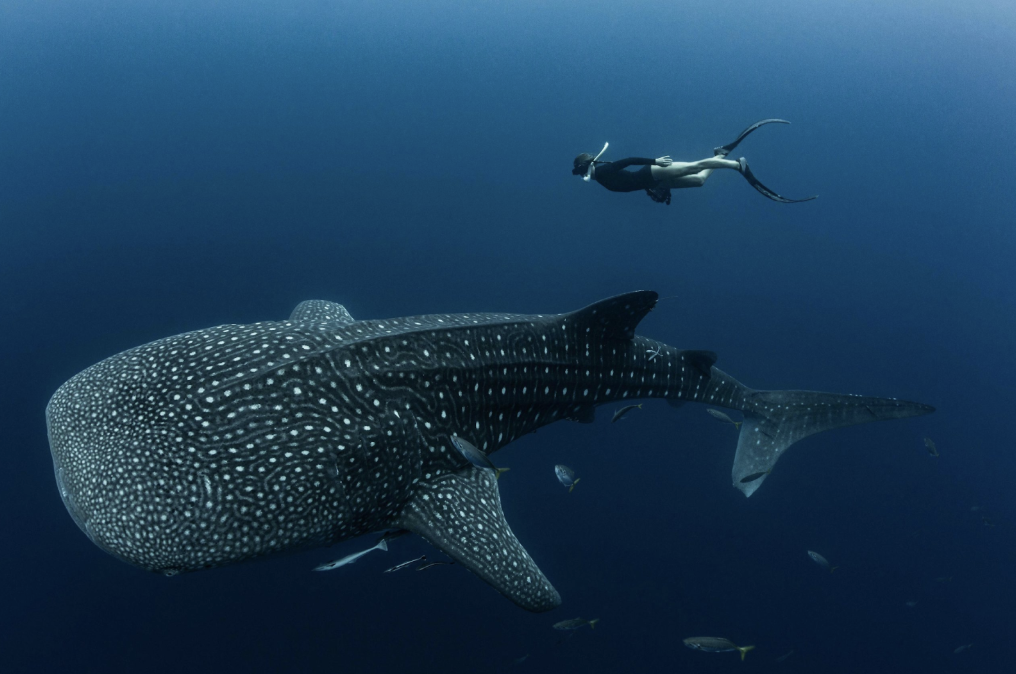
Whale sharks are the largest fish in the world, spanning up to 19 meters long and weighing up to 15 tonnes. Less than 16,000 whale sharks are left globally. Whale sharks have been steadily decreasing for 75 years without sufficient efforts to reduce key factors driving them to extinction. They currently face a range of threats, including vessel strikes, bycatch, tourism, and finning.
Vessel strikes are collisions between ships or boats with any form of marine life. These strikes cause severe blunt-force trauma, tears from propellers, and even death, in some cases. These vessel strikes often occur in shallow-water feeding aggregation sites that overlap with busy shipping lanes, particularly in the Arabian Sea, Gulf of Mexico, Gulf of California, and coastal areas of Southeast Asia, Australia, and the Philippines.
Bycatch is an accidental catch of the whale shark when fishing for other species. Bycatch is a significant factor contributing to the decline of protected species. It often results from non-selective fishing gear such as longlines, purse seine nets, and trawls.
One of the drivers to extinction that is hidden under a layer of doubt is tourism. Many people doubt that tourism can have such a harmful effect on these animals, but the wrong kind of tourism—unregulated, high-density, and interactive tourism that involves feeding, touching, or overcrowding—is doing precisely the opposite of helping. When commercial cruises and private boats embark on their journeys to find the whale shark, they quickly drive them away from their natural habitat, forcing them to seek refuge elsewhere.
With this in mind, there are non-harmful forms of tourism which can help the whale sharks. Non-invasive tourism with quiet engines limits disruption to these species. It is important for people to visit these beautiful whale sharks and raise awareness about the prominent issues at hand, but to also remain cautious about the way they are visiting them.
Finning, the most tragic of them all, is the cruel practice of removing their fins at sea and disposing of what is left of them. For over 400 million years, sharks have played a vital role in keeping our oceans healthy. They’re apex predators—balancing marine ecosystems, maintaining fish populations, and supporting coral reefs. But every year, tens of millions are killed for their fins—often while still alive. Of course, whale sharks cannot survive without their fins. They are left to die slowly: eaten, suffocated, or drowned. Whale sharks are hunted for their fins in the Indo-Pacific region, particularly in Indonesia, India, the Philippines, China, and Taiwan. Fins are used to make shark fin soup in Asia, which serves as a symbol of wealth and high status. But at what cost?
To save them from extinction, critical action must be taken. Some forms include enforcing shipping speed limits in migratory areas for both cargo ships and tourism boats, prohibiting shark fin trade, supporting sustainable ecotourism, and funding scientific research.