
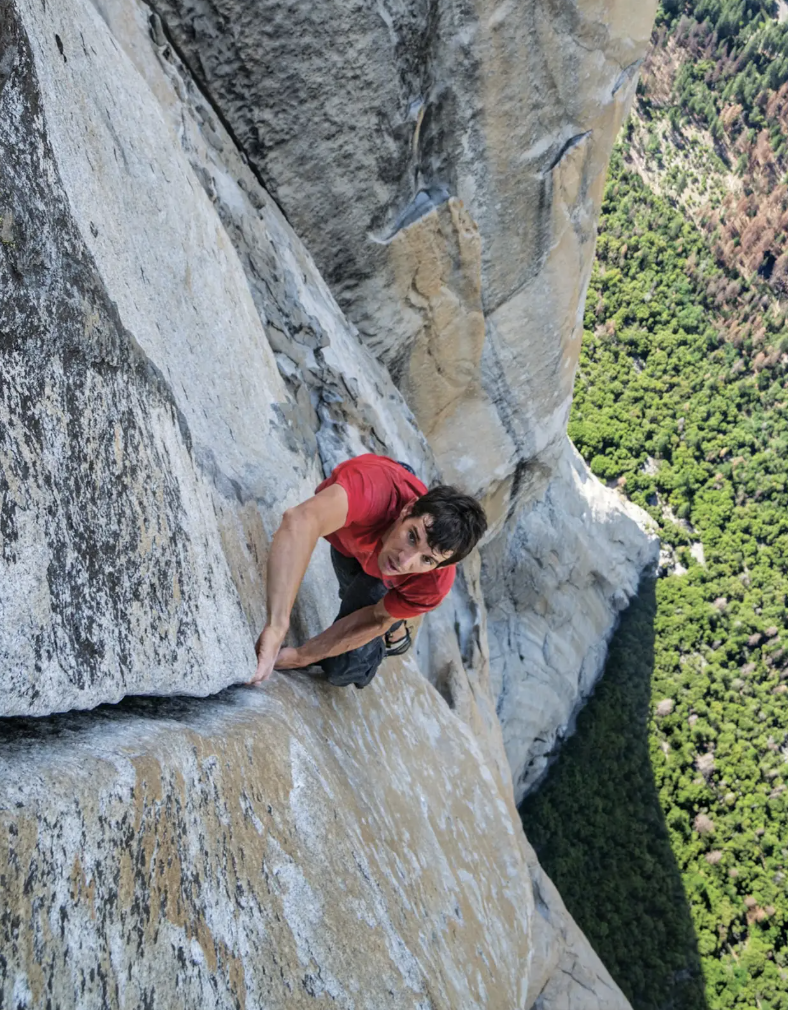
Climbing a vertical rock, thousands of meters high without ropes or safety equipment of any kind is an activity that doesn’t exactly find its way onto every person’s bucket list. Most are perfectly happy existing as a nervous spectator in the crowd that watches from afar as professionals gracefully scale cliffs. Some might rock climb as a recreational activity in a local gym; others may take part in competitions; the rest possibly choose to spend their weekends scaling boulders in nature to disconnect from the business of daily life and once again find their mind-muscle connection. Without a doubt, climbing is a great way to strengthen all kinds of muscles in the body that are rarely used, in addition to improving one’s ability to concentrate solely on one task. It’s also useful for learning how to maintain composure in stressful situations, where uncertainty is conquered so that thoughtful consideration of the next right move can occur —although climbing with ropes takes away some of the fear of falling.
That said, the few athletes that do free solo climbing are remarkable. Compared to the average person, the control they have over their mind and body is unmatched. Most will never understand what it takes to get to the point where one is able to keep their composure as their fingertips dig into a tiny crack and their feet rest on ledges that are less than a centimeter wide, knowing that any wrong move or slip up could be fatal. Voluntarily climbing sheer rock faces taller than most buildings without any safety equipment conveys a level of confidence and self-trust that is truly difficult to comprehend. But even if most of us will likely only become one of those climbers in our most extravagant fantasies, we can undoubtedly learn from the strategies, techniques, and mindsets that contribute to their ability to redefine what human beings are capable of.
One climber that is world-renowned for his achievements and mentality is Alex Honnold, a 40-year-old American. He first achieved true fame after freeclimbing El Capitan in Yosemite National Park in 2017—millions have since seen the documentary Free Solo, which captured his climb. Recently, on January 25th of this year, Honnold climbed the Taipei 101 skyscraper in Taiwan. Nervous spectators watched as he scaled the building, reaching the top after 92 minutes. He is the first to free solo the skyscraper, doing so with no safety equipment whatsoever. His only tools were his bare hands and some chalk. When reflecting on the climb he mentioned that the biggest challenge for him was staying calm, which was made more difficult with the large crowd watching him. He also shared that he relaxed as he climbed, realizing that he was doing it solely because he has fun. Afterwards, he had little to say, except, “It’s so great. What a nice day.” (Yeung et al.)
Most of his interviews portray a pattern in his mindset. He continues to climb because he enjoys doing it. This is important as motivations that are based on love and passion foster presence and a positive mindset, while ego-driven motives increase fear and distraction. His love for the sport no doubt plays a large role in his ability to scale the tallest structures in the world with no ropes. This devotion is likely present in most professional climbers. Free soloers consider climbing a “way of life” and view the sport as a way to improve many parts of themselves. Instead of chasing external validation through fame and attention, a stereotype that is common for those who voluntarily place themselves in extreme danger, climbers are propelled by self-actualization and a desire to fulfill their internal purpose. They know that the mental strength developed when managing the emotional rollercoaster they experience during climbs will not only improve their performance, but will also benefit them in daily life.
However, one of the most effective ways they are able to deal with those emotions effectively is through immense preparation before actually starting the climb. For example, Honnold climbed El Capitan 50 times with ropes before he went without them. He ingrained every movement in his mind and mentally rehearsed potential problems and his reactions to them. This type of visualization goes deeper than just an image the mind creates – he imagines what he would feel in different scenarios. Not only does this training improve confidence, but also increases trust in oneself, consequently making it easier to enter a flow state during a climb. This state of mind requires complete focus, and altered time perception, and a sense of natural control over their movements. Ultimately, fear arises from the unknown. But since climbers handle all the what-ifs beforehand, their anxiety is lowered to a manageable level.
What’s more, many free soloers explain that instead of trying to rid themselves of fear, they actually learn to work with it. They separate anxiety from real fear based on actual danger. Through focusing on what they can control, such as their breathing, where they look, and muscle tension, they reduce the risk of panic overwhelming them when hanging off a cliff. Most of us often worry about things that are fundamentally out of our control in our daily lives, like the actions of an unthoughtful person or perhaps the state of the weather before practice; but by following these athlete’s example, we too will be able to maintain a calmer mind through focusing on what is in our control and envisioning positive responses to adversity.
Furthermore, the science behind how our brains react to challenges or surprises in the actual moment is fascinating. Neuroscientist Jane Joseph put Hannold in an MRI scanner and showed him disturbing images meant to trigger strong reactions in his amygdala. This area of the brain is the threat response and fear center, interpreting information straight from our senses and making it so that the brain reacts to dangers before conscious thought, which leads to physical responses such as a racing heart, sweaty palms, and tunnel vision. Unsurprisingly, his brain stayed completely inactive. The control subject’s brain, however, lit up, as would most of ours. Hannold’s brain only showed color in areas that process visual input, which proved he was awake. One of the reasons for these differences undoubtedly relates to how he consistently thrives in life or death situations, so his mind has been trained to fear only when he is literally on the brink of dying during a climb.
He also scored high on conscientiousness, a trait which is basically obligatory if one is trying to ensure safety when free soloing. Austrian climber Paul Preuss believes that climbing without ropes is safer than using one (Guide), and this might have something to do with the fact that when the safety net goes away, conscientiousness becomes even more important; it develops into the only rope they have thousands of meters high in the air. Moreover, in other tests, Honnold was classified as a high sensation seeker—this could imply that he naturally has lower dopamine levels, which might drive him to look for extreme experiences that will effectively release the neurotransmitter. This might be one reason for his unfaltering love of free soloing, as it’s one of the most extreme things one can put themselves through. We are well aware that dopamine is addictive—it’s what keeps us scrolling at 2am—and it’s partly why climbers can become “addicted” to dangerous routes, as they know the feeling they will get during and after reaching the top.
So while we probably shouldn’t try to mimic free soloers through their addictive behaviours, there are so many things we can learn from them. In free soloing, the accomplishment is more preparation than performance; instead of relying on luck and chance, it is crucial they can depend on all their hard work leading up to the climb. In our daily lives, the real prize is staying consistent with the discipline we put into reaching mastery. Practice also builds confidence and trust in ourselves, as we know we have done everything possible to achieve success.
Preparation also involves managing the risks they can and anticipating the risks they can’t. By focusing on what we can control in school, sports, or relationships, and going through our responses to things that could go wrong beforehand, our mind will be in a much calmer state. Part of controlling the risks for climbers is trusting their intuition and turning around when something feels wrong; it’s especially important for them as it’s a matter of life and death. We have all experienced instances where we get a bad feeling about an event or a person beforehand, and then afterwards we realize that feeling was right. Learning to trust our gut is something that, while difficult, can be extremely beneficial.
Finally, in free soloing, there are no “short cuts.” Every movement must be carried out with extreme precision and thought, otherwise the climbers might face death. In life, it’s similar, although less extreme. In the long run, if we want the best results, being completely dedicated to everything we put time into is crucial. In the end, the dedication free soloers put into their craft and the training they put their mind and body through is beyond impressive. They are incredible role models for both other athletes and non-professionals, and the credit we give to their accomplishments often does not measure up to how difficult their sport is.
Bibliography:
(MLA citations)
Guide, Step. “The Hidden Psychology Behind Free Solo Climbing: What Drives These Athletes?” Dr Paul McCarthy, 16 October 2025, https://www.drpaulmccarthy.com/post/the-hidden-psychology-behind-free-solo-climbing-what-drives-these-athletes. Accessed 6 February 2026.
Wagner, Rodd. “The Seven Lessons From ‘Free Solo’ On Working Without A Rope.” Forbes, 1 March 2019, https://www.forbes.com/sites/roddwagner/2019/03/01/the-seven-lessons-from-free-solo-on-working-without-a-rope/. Accessed 14 February 2026.
Yeung, Jessie, et al. “Free solo climber Alex Honnold conquers one of the world’s tallest buildings.” CNN, 25 January 2026, https://edition.cnn.com/2026/01/25/sport/alex-honnold-taipei-101-free-solo-netflix-intl-hnk. Accessed 6 February 2026.