
The Swallows of Kabul is a novel written in 2002 by Mohammed Moulessehoul, who also works under the pseudonym Yasmina Khadra, which follows the story of a young woman under Taliban rule in 1998 in Kabul, Afghanistan. The novel was later adapted in 2019 as an animated film, which is the version discussed in the following article.
The Swallows of Kabul depicts a range of themes, but the most prominent is clear: the pursuit of freedom. This film beautifully portrays the indomitable human spirit, particularly through the main character, Zunaira, who is the wife of Mohsen, a former teacher. She is jailed for manslaughter and subversive behavior, where she displays moral strength and a refusal to submit to the Taliban despite several attempts to ‘break her.’ She and her husband – up until his death – are remarkably progressive and suffer under an oppressive regime that condemns education and personal liberty.
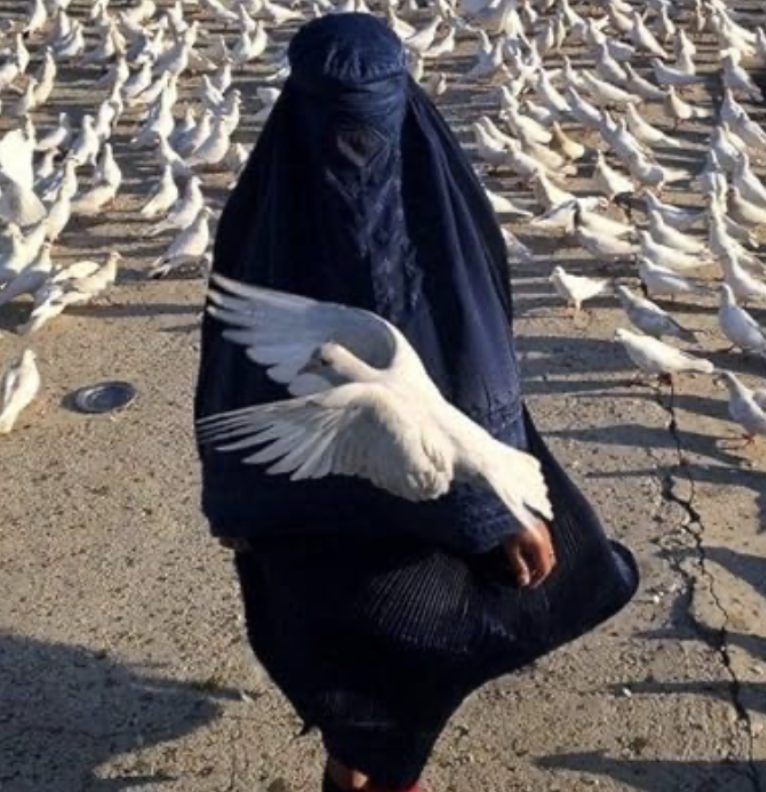
The character with the most moral strength is undeniably Mussarat, the wife of a Taliban officer. Despite being a secondary character, she takes the spotlight with a turn of events in the last scene. She is terminally ill, and upon hearing that Zunaira was to be publicly executed, she selflessly decided to take her place, surprising the characters and the audience alike. This was revealed only after she was stoned to death under her burqa, which, upon being removed, showed the face of the Taliban officer’s wife rather than that of Zunaira. In this scene, the burqa demonstrates how the enforced homogeneity resulted in the unfair murder of an innocent woman. Within the context of this movie, a women’s veil serves more than to display the literal reality of women living under the extremist group; it demonstrates how the erasure of women’s differences alienated them from individuality and agency, ultimately anonymizing their humanity and facilitating the brutality imposed onto them.
In a society full of generational hate and fear, Mussarat decided to act in love and compassion, reclaiming the agency stolen from her by the regime. Her sacrifice illustrates how the strength of the human spirit is not about individual survival but the preservation of human dignity and defiance. According to her, she wanted to protect a woman she knew would keep rebelling against the Taliban and who had the strength to make a change.
Stories like these are not completely fictional. The Taliban have long reigned in Afghanistan, but regained significant power in 2021. Women are currently facing oppressive restrictions on education, with UNESCO claiming that as of 2025, 2.2 million girls will have been completely excluded from education. Education has long been a tool for control, as a lack of it has been proven to increase an individual’s chances of believing and spreading misinformation, as well as having difficulty navigating social and economic changes. This leads to a reliance on government authority for direction and economic support, causing people to be impressionable and perpetuating the reign of terrorist groups like the Taliban.
Regarding the specifics of how this affects women, education has become a tactic to isolate women, completely removing their autonomy. Without access to education, girls are limited to domestic spaces, facing little opportunities for employment and therefore independence. As an act of resistance, small groups of women have started underground educational groups, risking severe punishment in the name of communal solidarity and empathy, unwaveringly hoping for the possibility of a better future.
Overall, The Swallows of Kabul illustrates the importance of empathy and undying hope. The film is an embodiment of what millions of girls and women are experiencing in Afghanistan, and how the human condition does not allow submission when faced with oppression.
Bibliography:
(MLA citations)
“UNESCO gives voice to Afghan girls and women and calls for their rights to be restored.” UNESCO, 2025. UNESCO, https://www.unesco.org/en/articles/unesco-gives-voice-afghan-girls-and-women-and-calls-their-rights-be-restored?utm_source=chatgpt.com.