
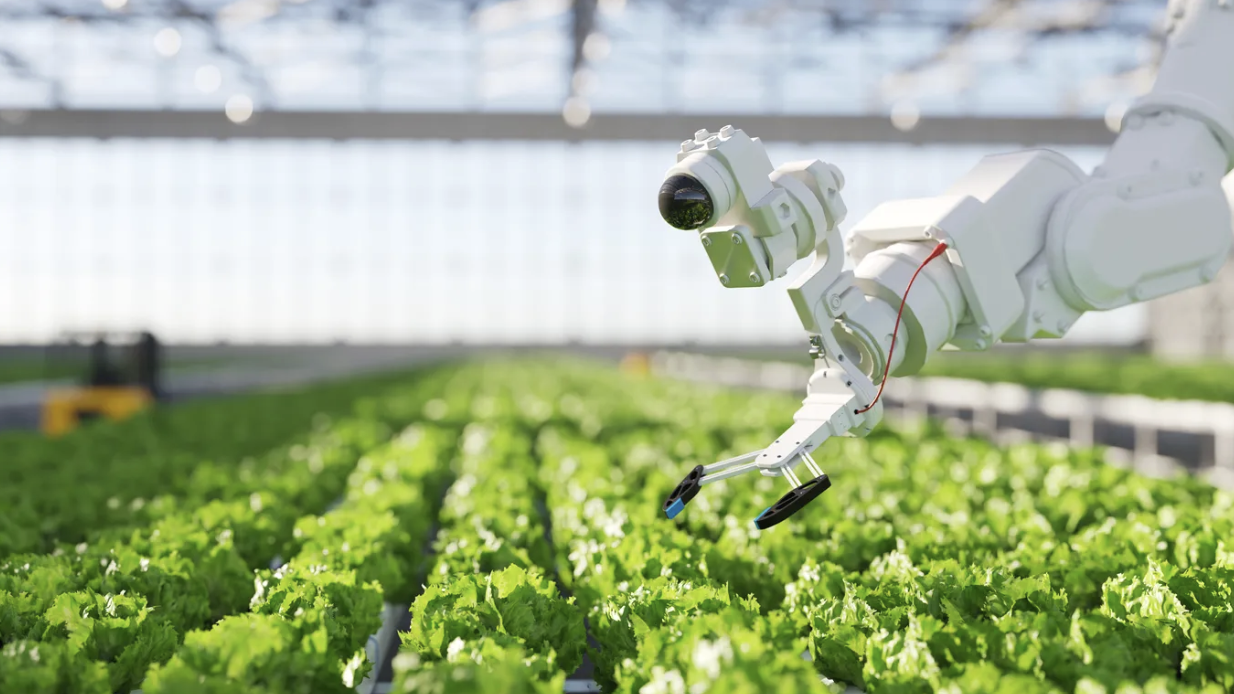
The world’s population is growing, and so is the demand for food. However, agricultural productivity “has slowed to a near-halt” (Sustainability Directory), suggesting that our society is not catching up with its food needs. Obviously, this has to be changed. We must ensure that we maximize our resource efficiency, especially in dry regions, specifically by optimizing the way we manage water and fertilizers. This would increase the crop yield our farms produce globally. But what can facilitate that? Correct! It’s technology.
As you might know, Spain has been recently experiencing drought-like conditions, which is signalled by the fact that in March 2024, the Spanish water reserve was only filled to 54.7% of its maximum capacity (The AGRARIA Project). In simple terms, it’s been a rough time for the Spanish farming community. Sadly, this situation has only been getting worse: as for now, Spain’s water reserves are filled to only 53.8% of their maximum capacity (Redaction). Here is where the first two words of the title of this article come into play: Tap Off — a performative way of saying that we need to save water and employ more cutting-edge, innovative water usage tools, or, in other words, utilize it more efficiently.
Here is where tech comes in: Tech On! Artificial intelligence, which is a huge part of modern technology in many other fields, is also a game-changer in sustainable agriculture. AI tools can perform a detailed analysis of data coming from sensors or images, measuring moisture level or soil content, ultimately optimizing water usage by helping farmers determine how much water a specific crop needs at a specific moment in time (Use of Ai in Agriculture & Farming). Such application of AI analysis prevents farmers from overusing water, boosting the overall efficiency. Sounds exciting and hopeful, doesn’t it?
Well, it’s a matter of fact that some organizations have already been trying to systemize and digitalize agriculture in order to minimize the waste of water and thus increase efficiency. Take project AgrarIA: as evident from the last two letters of its name, it introduced artificial intelligence models and climate data analysis into agriculture. GMV, an organization that leads the AgrarIA project, together with TERPO, one of Spain’s leading consultancy firms, has developed models that predict crop water requirements, potentially reducing the water used for food production up to 58% (The AGRARIA Project). Not too shabby, huh? Powered by AI, modern technology systems can indeed save water, and so to speak, hack drought in the regions where it is a serious issue.
Furthermore, there are other AI- and computing-driven projects that find their application in the Spanish agriculture sector. For instance, LSTMHybrid, developed on Python, utilizes neural networks and machine learning models to forecast irrigation water demand on a relatively large scale (Perea et al.). Another organization, called Neptuno Water Technology, treats agricultural wastewater with a goal to aid industries in optimizing their water resources (Tratamiento de Aguas Potables). Taking a turn from water usage to fertilizer management, the Spanish agricultural company Nutricontrol is offering smart and easy-to-integrate fertigation, or simply fertilizer injection, machinery that precisely injects the exact quantity of fertilizer that is needed for the crops (Automatic Equipment – Nutricontrol). Not less, and not more, because precision is the key in preserving resources, especially in agriculture.
In summary, I have been trying to show that firstly, applications of tech and AI are crucial in modern-day agriculture, especially in places where drought is likely to happen, as the food demand is progressively growing, while the supply of crops does not exhibit the same growth rate, and secondly, that Spain is already making promising leaps towards achieving sustainability goals in agricultural and food production industry.
The main takeaway from this article that I want to leave here with you, my dear readers, is that tech matters a lot in agricultural sustainability, especially now – and I mean it. So if you are a STEM person and you are interested in pursuing a career in science or engineering, consider sustainable agriculture. It is cool, impactful, and very, very important.
Bibliography:
(MLA citations)
“the Use of Ai (Artificial Intelligence) in Agriculture & Farming.” Www.agrirs.co.uk, www.agrirs.co.uk/blog/2024/02/the-use-of-ai-artificial-intelligence-in-agriculture-and-farming?source=google.com.
“Automatic Equipment – Nutricontrol.” Nutricontrol, 18 June 2024, nutricontrol.com/en/automatic-equipment/.
Perea, González, et al. “New Memory-Based Hybrid Model for Middle-Term Water Demand Forecasting in Irrigated Areas.” Helvia.uco.es, Elsevier, 2023, http://hdl.handle.net/10396/26233.
Portley, Jack. “5 Emerging Agri-Tech Trends – KnowHow.” KnowHow, 19 July 2023, knowhow.distrelec.com/it-and-digital/5-emerging-agri-tech-trends/.
Redaction. “La Reserva Hídrica Española Se Encuentra al 53,8 % de Su Capacidad.” Ministerio Para La Transición Ecológica Y El Reto Demográfico, 25 Nov. 2025, www.miteco.gob.es/es/prensa/ultimas-noticias/2025/noviembre/la-reserva-hidrica-espanola-se-encuentra-al-53-8—de-su-capacid.html.
Sustainability Directory. “Slowing Farm Productivity Threatens Global Food Supply and Future Price Stability → Food.” News → Sustainability Directory, 21 Nov. 2025, news.sustainability-directory.com/food/slowing-farm-productivity-threatens-global-food-supply-and-future-price-stability/.
“The AGRARIA Project Leverages Artificial Intelligence in Agriculture to Address the Water Crisis.” GMV, 8 May 2024, www.gmv.com/en-es/communication/press-room/press-releases/digital-public-services/agraria-project-leverages.
“Tratamiento de Aguas Potables Y Residuales.” Neptuno Water Technology, 9 Nov. 2025, neptunoes.com/.