
In recent years, the word mental health has seen an uprise. It seems as if, in one way or another, you find out about it, and people on the internet are constantly talking about it, and it’s not a bad thing. The Google Trends graph below shows the subject of mental health and its interest over 21 years. The graph shows a steady increase after 2016, leading up to the present day, and highlights how Gen Z uese social media plays a significant role in the increase of awareness of mental health.
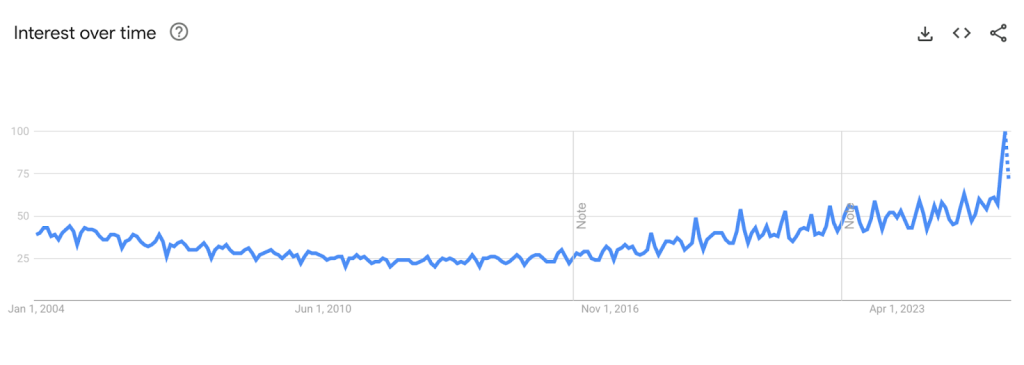
Graph of the Google searches with the word mental health from 2004 to the present day. https://trends.google.es/trends/explore?date=today%205-y&q=mental%20health&hl=en
With all that has happened in the last two decades, Gen Z has seen it all from the start of the online era, a global pandemic, to now, the start of the AI revolution. Experiencing so much of what Gen Z is going through, they are bound to have some mental health issues with the cost-of-living crisis around the globe; it is harder and harder to get by than for previous generations. The way that Gen Z express themselves is also immensely different compared to past generations. As a generation, they have been chronically online for as long as they can remember, so it’s natural for them to communicate in this way. With the combination of TikTok and the pandemic. Needless to say that people during this time were not doing well; as a result, people started posting about their struggles on social media. Slowly, with more and more people posting, the stigma surrounding mental health started to decrease, so much so that in the present day, there are 27 million videos under #mentalhealth on TikTok and 16.2 million videos under #mentalhealthmatters.
This increase in video creation surrounding mental health and the topic becoming less stigmatized was also partially caused by celebrities speaking up about their own mental health struggles. According to Howard Magazine, “In 2020, former first lady Michelle Obama publicly shared her experience with low-grade depression.” As a public figure, her confession was an important part of the increased discussion of mental health. Some celebrities, such as Simone Biles, Michael Phelps, Billie Eilish, Naomi Osaka, Prince Harry, and many more, have played a large role in this movement as well. Many of these celebrities, in fact, also have their own NGOs that help people get access to information about mental health and the help they need, with some notable ones being Selena Gomez with her Rare Impact Fund and the Lady Gaga: Born This Way Foundation. Other celebrities have also worked with numerous other NGOs that focus on mental health.
The promotion of mental health through people sharing their stories, struggles, and resources, spreads the topic to more people, who can then contemplate what they are seeing, see themselves reflected in these struggles, and ultimately do further research. They might start to look into what mental health is, see if some symptoms of a certain mental health disorder relate to them, and when they do, decide to get treatment and help if they need to and or to go to therapy. This awareness and sharing fosters a community where people feel safe and connected, making people feel less alone and much more willing to get diagnosed. That’s why it feels as if there has been a surge in diagnoses and why it seems as if almost everyone nowadays has a mental disorder. While the increase in videos and publicity around mental health has brought a lot of good, it has also brought some misinformation along with it. When this misinformation gets out to malicious people, they are likely to twist the words and create stereotypes that lead to more stigma, delayed treatment, or even worse mental health conditions. It is important to note that just relating to a video about some mental health disorder does not mean that you have the disorder indefinitely. If you do think that you have a mental illness, seek out a professional for a diagnosis and treatment, rather than solely relying on social media.
While the topic of mental health is trending, it is definitely not just a fad. It’s a shift in how we view mental health, driven by Gen Z using digital tools to break down old barriers. While the stigma hasn’t fully gone away yet, soon enough, with the way we are more informed about the topic, creating a world where talking about mental health is the norm, much like physical health, is inevitable.